
Two photos of the same cat are open on a phone. In one, she is stretched across a sunny window ledge, surrounded by plants and late-afternoon light. In the other, she is sitting upright, with her dark ears, pale chest, and slightly crooked tail clearly visible.
The first photo could become beautiful wall art. The second has the clean silhouette needed for a small three-dimensional keepsake. The choice is not about which format is more meaningful. It is about where the finished piece will live and which part of the pet you want it to preserve.
A custom pet keychain is usually the better fit for someone who wants a compact keepsake to carry carefully or display in a small space. A pet portrait is usually better for someone who wants wall art that preserves the original scene, background, and photographic composition. DoDoWish turns clear pet photos into a handcrafted three-dimensional figure keychain, so the best choice depends on space, routine, and the details that make the pet recognizable.
✦ Start With Where the Keepsake Will Live
Picture the finished piece after the wrapping is gone.
A portrait needs a wall, frame, shelf, or other stable display surface. It becomes part of the room. Its size, orientation, colors, and frame should make sense beside the furniture and artwork already there. It may also be visible to every guest who enters the space.
A pet figure keychain takes up much less room. It can hang from a handbag or backpack, rest near an entry table, sit beside a monitor, or remain inside a transparent showcase box. That flexibility suits apartments, dorm rooms, shared homes, and workspaces where a large framed piece may feel difficult to place.
Visibility matters too. Some pet owners want a portrait to anchor the living room. Others prefer a smaller reminder they can move, carry, or keep private. Before comparing materials or artistic styles, ask one practical question: where will this object naturally belong?
If you cannot name a wall, shelf, bag, desk, or display box, the format has not earned its place yet.
◇ What a Pet Portrait Preserves Best
A portrait begins with a flat image and keeps the viewer facing one composition. That can be a strength.
Choose a portrait when the background is part of the memory. A dog standing on a favorite beach, a cat asleep beneath a recognizable window, or a pet sitting between family members may need more than an isolated figure. The setting explains when and where the moment happened.
Portraits also work well when the pet owner already displays art or photographs. A wide canvas can hold multiple pets, environmental detail, and more negative space around the subject. The frame and color palette can become part of the room rather than a separate object placed on a surface.
The Smithsonian National Portrait Gallery has documented how dogs appear within portraits of their people, showing how a portrait can preserve a relationship as well as an individual subject. For a pet owner, that wider story may matter more than dimensional form.
There are practical limits. A portrait needs enough display space, and the recipient has to like the chosen art style. A large image can feel too public for someone who prefers private keepsakes. Original printed photographs also need protection from prolonged light exposure. The National Archives recommends displaying copies when light could damage important family photographs.
Choose the portrait when composition, setting, and wall presence matter most.
▹ What a 3D Pet Keychain Preserves Best
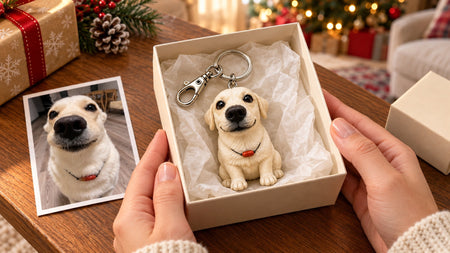
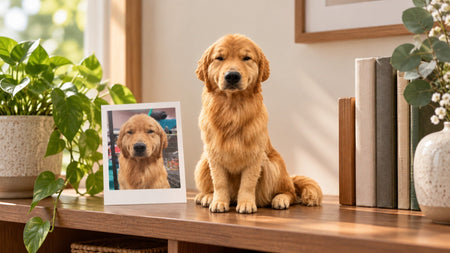
A three-dimensional pet keychain removes the background and gives the pet a physical silhouette. You can see the shape of the ears from the side, the curve of a seated posture, the coat boundary around the chest, and the position of the tail.
That makes the source photo work differently. A beautiful landscape is less useful than a clear view of the pet. The artisan needs readable facial features, body proportions, pose, markings, and accessories. Supporting views can clarify details that one photograph hides.
DoDoWish offers pet figure keychains in sizes from 5 cm to 10 cm. Each piece is shaped in artisan resin and finished with hand-painted details. The chibi proportions are intentionally compact, so the goal is not to reproduce every strand of fur. The goal is to preserve the visual cues an owner notices first: one dark ear, a white sock, a broad muzzle, a familiar seated pose, or an uneven patch around the eyes.
The hardware also changes how the keepsake can be used. It can attach to a bag or key ring, but its sculpted details still benefit from careful handling. Some owners choose to keep the miniature in its showcase box or place it on a desk instead. A keychain format provides options. It does not require the owner to carry it every day.
Before physical crafting begins, DoDoWish provides a 3D digital preview. This is the moment to check the overall silhouette, head-to-body proportion, ears, tail, coat colors, and attachment point. Revisions can be requested before approval.
Choose the keychain when dimensional likeness, compact size, and flexible placement matter most.
⌂ Compare Space, Detail, and Daily Use
The clearest choice usually appears when you compare how each format behaves in real life.
| Decision factor | Pet portrait | 3D pet keychain |
|---|---|---|
| Best location | Wall, mantel, or large display surface | Bag, entry table, desk, or showcase box |
| Visual emphasis | Composition, background, and surface style | Silhouette, pose, markings, and dimensional form |
| Interaction | Viewed mainly from the front | Held or viewed from several angles |
| Space needed | Depends on print and frame size | Compact |
| Portability | Low | High, with careful handling |
| Best source photo | Clear face plus a strong overall composition | Clear face, body shape, pose, and markings |
| Main gift risk | Art style may not suit the recipient's home | Carrying or display habit may not suit the recipient |
The verdict is simple. Choose a portrait when the photograph is already a complete scene and the recipient wants wall art. Choose a 3D pet keychain when the pet itself should become a compact object that can move between a bag, desk, and display box.
The best format is the one with a believable place in the owner's daily life.
Give One Familiar Pet a Three-Dimensional Form
Choose a clear photo, then review the silhouette and markings before physical crafting begins.
Create a Custom Pet Keychain
♡ Two Customers, Two Ways to Keep Pets Close
Product categories become easier to understand when you see where real owners put them.
Three cats in one compact display
Pam L. ordered three cat miniatures and shared two verified reviews with photos. Instead of treating each piece only as a keychain, she stacked the transparent showcase boxes and displayed the cats together. She liked that the arrangement saved space and also suggested the figures could work as tree ornaments.
Her setup changes the usual portrait comparison. A wall piece can group several pets in one composition, but three small figures can preserve each cat as an individual object while still creating one vertical display. The boxes give every miniature its own boundary without requiring three separate frames.
Pam also described the pieces as delicate for keychain use. That detail matters. Someone who loves miniature sculpture but carries a crowded key ring may prefer a desk, shelf, seasonal ornament, or protected bag position.
Recognizing Henry at miniature scale
Kim H. focused on a different question: did the finished keychain resemble her pet? In her verified photo review, she described the process as smooth and said the keychain “looks like my Henry.”
The review does not explain where she carries or displays it, so there is no reason to invent that part of the story. What it does show is the standard that matters at small scale. A miniature succeeds when the owner recognizes the specific pet before needing a caption.
For some people, that recognition comes from the face. For others, it comes from a resting pose, a chest marking, a tail shape, or the way the ears sit. Those cues should control the reference photos and preview review.

✓ Choose the Photo for the Format
The same pet may need different source images for a portrait and a figure keychain.
For a portrait, start with the whole frame. Check whether the eyes are sharp, the expression feels familiar, and the background adds meaning instead of clutter. Consider whether the image is vertical or horizontal and whether the subject will remain clear at the intended wall size.
For a keychain, isolate the pet mentally from the background. Can you see the head shape, muzzle, chest, legs, and tail? Are the coat colors honest, or has warm indoor light shifted them? Does the pose remain readable when reduced to a few inches?
The American Kennel Club's pet photography guidance recommends working at the dog's eye level, focusing on the eyes, and photographing details that express character. Those choices also produce clearer visual evidence for a custom keepsake.
One strong image can lead the design, but supporting views should answer specific questions. A side view can show muzzle length and tail shape. A full-body photo can clarify proportions. A close-up can confirm eye color or a marking around the nose.
Avoid sending a large collection of contradictory photographs without instructions. Choose one primary image for the pose, then state what each supporting photo should clarify. The detailed DoDoWish photo guide for custom pet figurines explains how to check face, ears, expression, markings, body proportions, tail, and accessories before approval.
❖ Match the Keepsake to the Recipient
A personalized gift can still be a poor fit when it ignores the recipient's habits.
Choose a pet portrait for someone who already has a gallery wall, displays family photographs, or wants the pet shown within a meaningful setting. It is also the stronger choice when several animals and people need to appear together in one scene.
Choose a pet keychain for someone who likes miniature objects, changes bags often, decorates a workspace, or has limited room for framed art. It can be a lower-footprint way to keep one pet visible without asking the recipient to redesign a wall.
For someone who follows fashion accessories, the pet bag charm guide shows how a custom miniature can join a handbag or backpack without becoming a generic character charm.
Avoid choosing a portrait as a surprise when you do not know the recipient's preferred art style or display space. Avoid choosing a keychain when the person dislikes bag accessories, carries keys loosely with heavy objects, or would rather keep a fragile miniature protected.
Pet memorials are one valid use, but they are not the only reason to commission either format. A living pet's birthday, a Gotcha Day, a first apartment, a move away from home, or an ordinary favorite photo can be enough. The object should support the relationship that already exists rather than force a more dramatic story onto it.
✦ Review the Preview and Plan the Timing
A portrait proof and a three-dimensional preview require different checks.
For a portrait, review crop, orientation, background treatment, color palette, and the artist's level of interpretation. Confirm whether the result will preserve the original setting or simplify it.
For a DoDoWish pet keychain, review the largest structural choices first:
- Confirm the correct pet, pose, and number of subjects.
- Check the silhouette and head-to-body proportion.
- Compare the ears, muzzle, legs, paws, and tail with the photos.
- Check coat colors and the placement of distinctive markings.
- Confirm the keychain attachment point and any requested accessory.
Do not begin with a tiny eye-color adjustment if the body shape is wrong. Correct the structure first, then move to painted details. View the preview beside the reference photos instead of relying on memory.
After preview approval, DoDoWish crafting takes 10 to 15 business days. Shipping takes another 7 to 10 business days. Leave additional time for photo selection, preview review, and any revisions. For a birthday or holiday, work backward from the gift date instead of approving an incorrect detail to save a few days.
The finished piece arrives in a premium gift box, which can also provide a protected place for storage or display when the keychain is not being carried.
◇ Choose the Form That Belongs in Their Routine
Return to the two cat photos. The window scene belongs on a wall if the afternoon light and familiar room are part of the memory. The clear seated pose belongs in three dimensions if the crooked tail, pale chest, and shape of the ears are what the owner wants to recognize.
Neither choice replaces the photograph. Each one edits the memory differently.
A portrait keeps the scene. A custom pet keychain keeps the pet's shape in a compact object that can sit nearby or travel carefully. Choose the place first, then the visual details, then the format. That sequence is more reliable than choosing whichever product looks most impressive on a shopping page.
Start With the Pet They Know by Heart
Turn one clear pet photo into a handcrafted miniature for a bag, desk, or showcase box.
Start Your Pet Keychain- Hand-sculpted form and hand-painted pet details in artisan resin
- 3D digital preview with revisions before physical crafting
- Pet keychain sizes from 5 cm to 10 cm
- 10 to 15 business days crafting, followed by 7 to 10 business days shipping
Frequently Asked Questions
Is a custom pet keychain better than a pet portrait?
A custom pet keychain is usually better when the owner wants a compact keepsake for a bag, desk, or showcase box. A pet portrait is usually better when the original setting matters and the owner has suitable wall or display space. The stronger choice depends on the recipient's routine and preferred way of seeing the pet.
What photo works best for a custom pet keychain?
Use a clear, well-lit photo that shows the pet's face, body shape, pose, and distinctive markings. An eye-level front or three-quarter view can lead the design, while side and full-body photos can clarify the ears, muzzle, proportions, tail, and coat pattern.
Can a pet keychain be displayed at home?
Yes. A three-dimensional pet keychain can sit on a desk or shelf, remain in a transparent showcase box, or be arranged with other small keepsakes. Displaying it at home can be a practical choice for someone who likes miniature objects but has limited room for framed wall art.
Is a custom pet keychain a good memorial gift?
It can be a thoughtful memorial gift when the recipient wants a small likeness of one specific pet. Before ordering, confirm that the person is comfortable receiving a visual keepsake and consider whether they would prefer to carry it, display it privately, or keep it protected in its box.
How long does a DoDoWish custom pet keychain take to make?
DoDoWish crafting takes 10 to 15 business days after preview approval, followed by 7 to 10 business days for shipping. Allow additional time to select photos, review the three-dimensional digital preview, and request any revisions before physical crafting begins.